


Why successful companies still miss revenue targets despite great products and smart teams
You’ve invested millions in R&D. Your product portfolio is strong. Your teams are talented and hardworking. Your market strategy looks solid on paper. Yet somehow, quarter after quarter, your organization falls short of growth targets that should be well within reach.
If this scenario sounds familiar, you’re experiencing what we call the hidden tax of organizational misalignment—a silent revenue drain that’s costing enterprises far more than most executives realize.
The root cause is deceptively simple: your departments are making strategic decisions based on different assumptions about what customers actually want. Marketing targets demographic segments, Product optimizes for feature engagement, Sales focuses on deal-closing capabilities, and R&D invests in emerging technologies—all without a shared understanding of customer needs.
This situation creates systematic misalignment where rational departmental decisions compound into organizational dysfunction, turning your competitive strengths into coordination weaknesses.
The $10 Million Question Every CEO Should Ask
Here’s a startling reality that should concern every C-suite executive: Poor organizational alignment costs businesses 10% or more of their annual revenue (Demandbase, 2024)¹. For a company generating $100 million annually, that’s at least $10 million in lost growth—money that’s slipping through organizational cracks while leadership focuses on external competition and market dynamics.
Even more troubling? 48% of enterprises still struggle with alignment despite knowing its importance (Demandbase, 2024)¹. This isn’t a problem that organizations simply grow out of or solve with good intentions.
Executive Decision Point: When did you last quantify the cost of misalignment within your organization? Most executives track competitor analysis religiously but have never calculated their internal coordination tax.
Why Smart Teams Make Disconnected Decisions
The symptoms are everywhere, yet they’re often misdiagnosed as execution problems rather than alignment issues. The root cause runs deeper than most organizations recognize. It’s not about talent, effort, or even individual decision-making quality. The fundamental problem is that smart teams are making strategic decisions based on different sources of truth about what customers actually want.
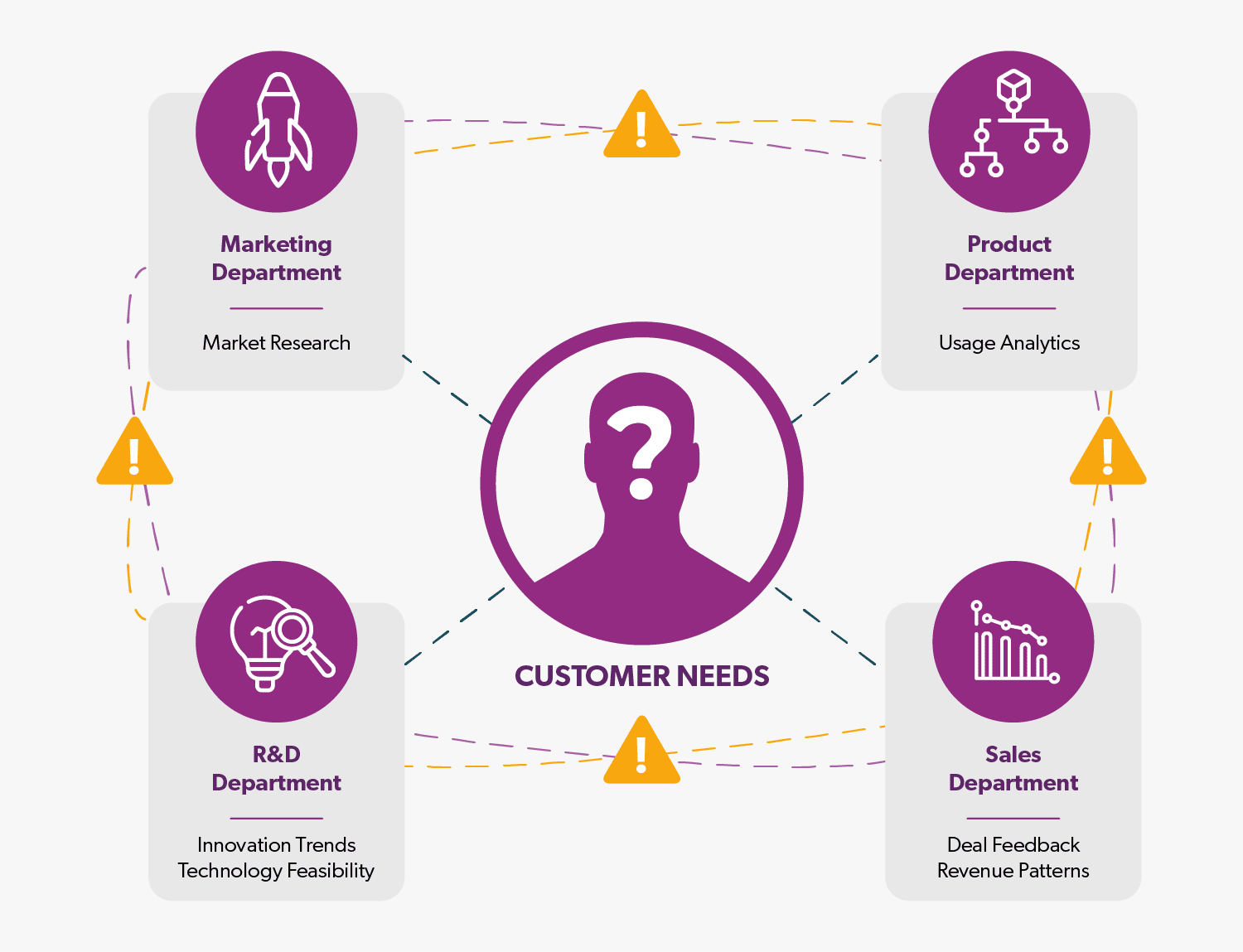
Consider how this plays out across a typical enterprise:
- Marketing develops campaigns targeting demographic segments based on market research
- Product builds features prioritized by usage analytics and competitive analysis
- Sales pitches capabilities and solutions based on revenue patterns and deal feedback
- R&D invests in technologies guided by innovation trends and technical feasibility
Each data source is valid. Each department is making logical decisions based on their information. Yet the organization lacks a single source of customer truth that all teams can use to make coordinated strategic choices.
This data fragmentation creates what organizational researchers call “phantom targets”—customer segments that exist in departmental spreadsheets but don’t reflect how real customers actually behave or make purchasing decisions. The result? Even the most capable teams work at cross-purposes, creating a cascade of coordination failures that show up in measurable business impact.
Each decision is rational within its departmental context. The irrationality emerges at the organizational level, where the absence of a single source of customer truth creates systematic misalignment that compounds over time.
The Hidden Tax Calculation
Let’s quantify what misalignment actually costs your organization:
Revenue Impact Assessment:
- If your organization generates $500M annually, 10% misalignment tax equals $50M in lost growth
- This exceeds most companies’ entire marketing budgets
- It typically surpasses annual R&D investments
- It often represents more than the total compensation for senior leadership
Strategic Execution Failure Costs:
- 67% strategy failure rate (Harvard Business Review, 2017)² means organizations restart strategic initiatives multiple times
- Each restart requires new resource allocation, timeline extensions, and opportunity costs
- Failed strategies create organizational cynicism that makes future alignment even more difficult
Product Development Inefficiency:
- 45% of launches delayed (Gartner, 2019)⁵ means extended time-to-market and competitive disadvantage
- Delayed launches often miss optimal market timing windows
- Coordination rework consumes resources that could drive innovation
The Single Source of Truth Solution
The most successful organizations solve this challenge by creating a single source of customer truth that all departments use for strategic decision-making. Instead of each function operating with different customer assumptions, aligned organizations base all strategic choices on unified customer insights.
This isn’t about forcing departments to abandon their specialized metrics—it’s about providing a common foundation that informs how those metrics get interpreted and applied.
Consider the difference:

All strategic decisions evaluate: “Does this help customers get their job done better?” All investments prioritize based on quantified unmet customer needs. All teams speak the same language about customer value creation.
How Outcome-Driven Innovation Creates Your Single Source of Truth
You’ve identified that your organization needs a single source of customer truth. The question is: how do you create it? Outcome-Driven Innovation (ODI) provides the proven methodology for developing customer insights that all departments can use as their strategic foundation.
Unlike traditional market research that fragments organizations with demographic segments and feature preferences, ODI aligns organizations around what customers are actually trying to accomplish. The approach centers on Jobs-to-be-Done theory: customers don’t buy products, they “hire” solutions to get important jobs done in their lives.
ODI creates organizational alignment through desired outcome statements—precise descriptions of what customers want to achieve when getting a job done. These statements become the universal language that all departments use for strategic decision-making:
- Marketing campaigns target customers with specific unmet outcomes
- Product development prioritizes features that address the highest-value unmet outcomes
- Sales conversations focus on which outcomes the solution helps customers achieve better
- R&D investments concentrate on technologies that enable superior outcome achievement
The result? Organizations achieve an 86% innovation success rate compared to the 17% industry average. More importantly, all teams work from the same customer playbook, eliminating the coordination failures that create the hidden tax of misalignment.
When every department bases decisions on the same quantified understanding of customer needs, the phantom targets disappear. Strategic initiatives align naturally. Resource conflicts resolve based on customer data rather than internal politics. The organizational irrationality transforms into systematic competitive advantage.
The Executive Choice: Accept the Tax or Address the Root Cause
Every executive faces a fundamental choice about organizational alignment:
Option 1: Accept the Hidden Tax
- Continue operating with departmental silos and different customer assumptions
- Accept 10% revenue loss as “the cost of doing business”
- Restart failed strategies when coordination issues emerge
- Compete with one hand tied behind your back while aligned competitors pull ahead
Option 2: Create Your Single Source of Truth
- Establish unified customer insights that guide all strategic decisions
- Align departmental priorities around common understanding of customer needs
- Eliminate wasteful coordination cycles and strategic restarts
- Gain sustainable competitive advantage through organizational coordination
The choice seems obvious, yet implementation requires executive commitment and systematic methodology. Creating alignment isn’t about good intentions or team-building exercises—it requires a proven framework for developing customer insights that all departments can use as their strategic foundation.
Your Next Step: Start Building Your Single Source of Truth
The hidden tax of organizational misalignment doesn’t have to be permanent. While 48% of enterprises continue struggling with coordination despite knowing its importance, forward-thinking executives are taking action to create their single source of customer truth.
The first step is recognition. Most organizations underestimate their alignment tax because the costs are distributed across departments and show up as missed targets, delayed launches, and strategic restarts rather than line items on financial statements.
Take a moment to consider your organization:
- How many strategic initiatives have been restarted due to “coordination issues”?
- Which departments operate with different definitions of customer success?
- How often do marketing campaigns, product features, and sales messaging seem disconnected?
- What percentage of your product launches experience delays that aren’t technical in nature?
If these scenarios sound familiar, your organization is likely paying the hidden tax. The good news? ODI provides a systematic approach for creating the customer insights that eliminate this organizational fragmentation.
Companies that implement Outcome-Driven Innovation don’t just solve their alignment problems—they transform organizational dysfunction into competitive advantage. When every department makes decisions based on the same understanding of customer needs, strategic execution becomes predictable rather than hopeful.
The question isn’t whether your organization has an alignment challenge. The question is whether you’ll continue accepting the revenue drain or take systematic action to address the root cause.
CITATIONS AND SOURCES
- Demandbase (2024). “The Cost of Misalignment: Why Sales & Marketing Need to Get on the Same Page.” Demand Gen Report, November 2024.
- Harvard Business Review (2017). “Executives Fail to Execute Strategy Because They’re Too Internally Focused.” November 2017.
- Gartner (2019). “Gartner Survey Finds That 45 Percent of Product Launches Are Delayed by at Least One Month.” September 9, 2019.