

Jobs-to-be-Done (A Comprehensive Guide)
Innovation is the key to success, but how can you make innovation more predictable and profitable? The answer lies in adopting a new perspective: Jobs-to-be-Done (JTBD).
Table of Contents
Harvard Business School marketing professor Theodore Levitt said, “People don’t want a quarter-inch drill; they want a quarter-inch hole.” This simple shift in perspective can transform your approach to innovation.

You’re opening doors to solve problems beyond just making a hole.
• Why are they drilling that hole in the first place?
• What’s the real job they’re trying to accomplish?
That’s where the real innovation happens. That’s how you transform your team into genuine problem solvers.
It’s a game-changer.
It’s time to stop thinking like a drill-maker and start thinking like a customer-centric innovator.
This comprehensive guide explains the core concepts of JTBD, demonstrates how to apply it to your business, and showcases real-world examples of its success.
Learning Jobs-to-be-Done Theory
JTBD Theory is based on the notion that people buy products and services to get “jobs” done.
As a result of this framework, a complete set of need statements can be developed in days rather than months, and the statements themselves can last for years instead of quickly becoming obsolete.
Consider the job of listening to music on the go.
Over the past few decades, we’ve seen products evolve from records to cassette tapes, CDs, MP3 players, and streaming services. But while technology is continually changing, the job of listening to music has stayed constant.

JTBD Theory, therefore, instructs that companies should stop focusing on the product, the technology, or the customer. Instead, focus on the underlying process or job the customer is trying to get done. This allows you to understand customer needs in an entirely new way, making innovation more predictable.
Jobs-to-be-Done Examples
As a kettle maker, it would be easy to conclude that people buy your product to boil water. But boiling water is just a step in the real job the customer is trying to get done — which is to prepare a hot beverage for consumption.
If the business keeps making kettles without focusing on the entire job, they are at risk of disruption by a competitor with a solution that gets the entire job done on a single platform (like Keurig).
It is not uncommon for a new competitor to overtake a market by finding the resources, funding, and technology, and developing the know-how and capabilities to create an offering that gets the entire job done.
For examples of Jobs-to-be-Done in financial services, medical devices, and software, read about three cases that further illustrate the concept.
Testimonials
What people who have used Jobs-to-be-Done are saying





How JTBD Benefits Your Business
How the Jobs-to-be-Done framework benefits your business
Understanding your customer needs through JTBD offers a variety of benefits to the business. Most notably, JTBD allows you to:
- Break down functional silos and align teams. With Jobs-to-be-Done, all functions in the business can align around a common understanding of the customer and how to add value for that customer.
- Create winning products. With a thorough, step-by-step understanding of what your customer’s job entails, you are far more likely to create solutions that will win in the marketplace — the first time around.
- Communicate offerings effectively. Jobs-to-be-Done helps marketers align the entire organization around a clear and consistent messaging strategy that speaks to the problem.
JTBD also provides valuable insights for specific business functions and roles.
Executives
Executives can use JTBD to confidently grow the business with answers to questions like:
- How can we align our teams around value creation?
- Are we delivering on customer-centricity?
- What should we innovate to become a preferred solution in the market?
- What non-traditional competitors should be on our radar?
Learn More: JTBD for Executives
Product managers
Jobs-to-be-Done helps product teams to launch hugely successful products by answering questions like:
- Do our products get the entire job done, or only parts of the job?
- What holes exist in our portfolio?
- Are customers cobbling together solutions to get the entire job done?
- What product in our portfolio holds the potential to get the entire job done?
Dive Deeper: JTBD for Product Managers
Product development
It’s not enough just to come up with a brilliant product idea — developers must also successfully execute that idea. JTBD provides developers with important insights like:
- Does our product architecture allow the customer to complete the job?
- If not, where are they struggling?
- How effective is our user interface?
- How can we improve our user experience and customer experience?
Learn More: JTBD for Developers
Marketers
JTBD helps marketing teams to position and communicate products and services most effectively with answers to questions such as:
- How can we better market/position our current offerings?
- How should we modify our marketing communications?
- How should we adjust our content?
Step by Step Guide
A Step by Step guide to Implement the Jobs-to-be-Done framework in your Business
Winning at innovation means targeting the right market, understanding the customer’s needs, discovering segments of customers with different unmet needs, and addressing the targeted needs with solutions that get the job done significantly better.
Strategyn has created four Jobs-to-be-Done Frameworks that will guide you through each step of the process. They will help you start on the right foot and avoid the pitfalls that often derail innovation efforts.
Strategyn’s Jobs-to-be-Done Frameworks:
The JTBD Market Definition Canvas:
Market definition is often random and left to chance. Define it as a group of people trying to get a job done.
The JTBD Job Mapping Canvas:
First published in HBR, the canvas begins the needs discovery process with a deep understanding of what the customer is trying to accomplish at each job step.
The JTBD Customer Needs Framework:
Gain clarity on the three types of customers: The Job executor, the Purchase decision maker, and the product life cycle support team.
The JTBD Growth Strategy Matrix:
Know when to employ differentiated, dominant, disruptive, discrete, and sustaining strategies to win in the marketplace.
These Jobs-to-be-Done Frameworks help innovators adopt a new mindset and put Jobs Theory into practice.
Step 1: Define Your Market With JTBD
Companies use various, seemingly random classification schemes to define the markets they serve. We’ve seen teams choose to define markets around products, demographics, personas, use cases, geographies, and more.
The point is, that when the market definition process is obscure, random, and left to chance, teams can inadvertently choose to define markets in ways that cause them to churn, pivot, and fail.
There is a solution: define a market as a group of people and the job they are trying to get done.

Defining a market around the job-to-be-done provides a stable, long-term focal point around which companies can create value.
The JTBD Market Definition Canvas, below, helps the innovator move from a product mindset to a problem mindset while defining the market being served.
The benefits are far-reaching: a market defined through a JTBD lens is stable over time, actionable, and dramatically simplifies the needs discovery process.
For a more detailed guide and video tutorial, Check out Chapter 2 of the Jobs-to-be-Done Playbook

Step 2: Map your Customer’s Job-to-be-Done
Strategyn first introduced the concept of job mapping in the 2008 Harvard Business Review article, “The Customer-Centered Innovation Map.”
A job map is not a process map or a customer journey map.
It does not describe what the customer is doing.
Rather, it depicts what the customer is trying to get done in the ideal order for efficient execution.
The job map reveals opportunities to help customers get their job done better and provides a structure for needs gathering.
All jobs are made up of the same eight steps:
- Define. Determine objectives and plan their approach.
- Locate. Gather the inputs required to get the job done.
- Prepare. Set up and organize the inputs.
- Confirm. Confirm that everything is in place to complete the job.
- Execute. Complete the job correctly.
- Monitor. Make sure things are going well during execution.
- Modify. If monitoring indicates a problem, adjust to fix it.
- Conclude. Clean up, dispose of supplies, etc.

We’ve found that the average job consists of anywhere from 10 to 20 of these steps. Using the Jobs-to-be-Done framework, your goal is to look for opportunities to help customers and improve their experience at each one.
While you might think you have a good understanding of your customer’s job and can create the job map yourself, the best job maps include customer insights gleaned from interviews. With the right interview techniques, you’ll be able to tease out:
- A complete list of steps required for completing the job
- If and how the customer struggles at each step
These pain points can be translated into comprehensive customer needs and desired outcomes, which you can then address through your product and service innovations.

A completed job map provides customer insights at the 10,000-foot level — and the structure to understand customer needs at a very granular level.
Download the job map template and begin building your job map today.

For a more detailed guide on building your job map, check out Chapter 3 of the Jobs-to-be-Done Playbook
Step 3: Identify your Customer Needs with JTBD
Understanding your customers is paramount for your products to be successful. But before diving into their needs, it’s crucial to identify who these customers actually are. This process varies significantly between B2C and B2B companies, with the latter often facing more complexity.
Our extensive research has led us to identify three distinct customer roles that are applicable across various industries:
- The Job Executor: This is the primary user of the product, the person who employs it to accomplish the core functional job.
- The Product Lifecycle Support Team: This group encompasses various individuals who interact with the product throughout its lifecycle, including those who install, transport, repair, maintain, upgrade, or dispose of the product. They perform what we call “consumption chain jobs.”
- The Buyer: This is the individual or group responsible for making the financial purchase decision.

In B2C markets, these roles often overlap. A person buying a smartphone, for instance, is likely to be the user, the one who keeps it charged and updated, and the purchaser.
However, B2B scenarios typically involve a more distributed model. Consider enterprise software: developers use it, IT staff maintain it, and C-level executives approve its purchase.
This classification forms the cornerstone of our innovative approach to understanding customer needs. It’s particularly valuable because each group brings unique perspectives and requirements to the table.
By recognizing these distinct roles, companies can develop more comprehensive strategies that address the full spectrum of stakeholder needs. This approach ensures that products not only perform well for end-users but also satisfy the concerns of those involved in their acquisition and upkeep.
Step 4: Growth Strategies Using Jobs-to-be-Done (JTBD)
The core principle of innovation is to help customers complete their jobs better or more affordably.
The JTBD Growth Strategy Matrix outlines five key strategies based on this idea. It explains each strategy when to use it, and what you need for success.
The Jobs-to-be-Done Growth Strategy Matrix helps you choose the right strategy (disruptive, sustaining, differentiated, dominant, or discrete) for your specific market segment and when to use it.
- Differentiated Strategy
- Best for: Customers who are underserved and willing to pay more for better solutions
- Approach: Offer a superior product at a higher price
- Dominant Strategy
- Best for: All customer types, including underserved, overserved, and non-consumers
- Approach: Provide a solution that’s both better and cheaper
- Disruptive Strategy
- Best for: Overserved customers not willing to pay more, and non-consumers
- Approach: Offer a simpler, cheaper solution that meets basic needs
- Discrete Strategy
- Best for: Customers with limited or no other options
- Approach: Provide a solution for specific situations where alternatives are scarce
- Sustaining Strategy
- Note: Better for established companies than new entrants
- Best for: Customers whose needs are mostly met
- Approach: Make small improvements to existing products

By understanding these strategies, you can choose the best approach for your market and customer needs, increasing your chances of successful innovation.
The History of Jobs-to-be-Done
Clayton Christensen may have popularized Jobs-to-be-Done in his 2003 book The Innovator’s Solution — but it was Tony Ulwick who introduced him to the concept.
Tony Ulwick conceptualized JTBD in 1990 by applying Six Sigma thinking to the innovation process.
His first major success using this methodology came in 1992 when he helped Cordis Corporation reinvent its line of angioplasty balloon products. Cordis’ market share increased from 1% to more than 20%, and the company’s stock price more than quadrupled.
In 1999, Ulwick officially named his innovation process Outcome-Driven Innovation (ODI), and he had the pleasure of introducing ODI to Harvard Business School professor Clayton Christensen.
Christensen also saw the value of making the “underlying process the customer was trying to execute.” He introduced what he called Jobs-to-be-done Theory in his 2003 book, citing Strategyn’s work in job and outcome-based thinking, market segmentation, and the ODI process.
JTBD Training & Tools
There are a variety of resources to help you learn how to put Jobs-to-be-Done Theory into practice for your business.
Jobs-to-be-Done training | ODIpro
Strategyn offers a guided approach to your learning.
Our ODIpro platform gives you the training and tools to apply Jobs-to-done and the world’s most advanced innovation process in your organization.
ODIpro Includes:
- Master JTBD & ODI with interactive courses, quizzes, and workbooks
- Apply JTBD & ODI principles with tools and templates
- Figure out tough problems with innovation professionals


Free Download | The JTBD Book
Tony Ulwick’s Jobs to be Done: Theory to Practice book is the most popular book on JTBD. You can download a copy of the e-book and/or audiobook for free. The book walks you through a thorough explanation of Jobs Theory and how it can be applied to business and product innovation through the ODI process.
Download The Free Book
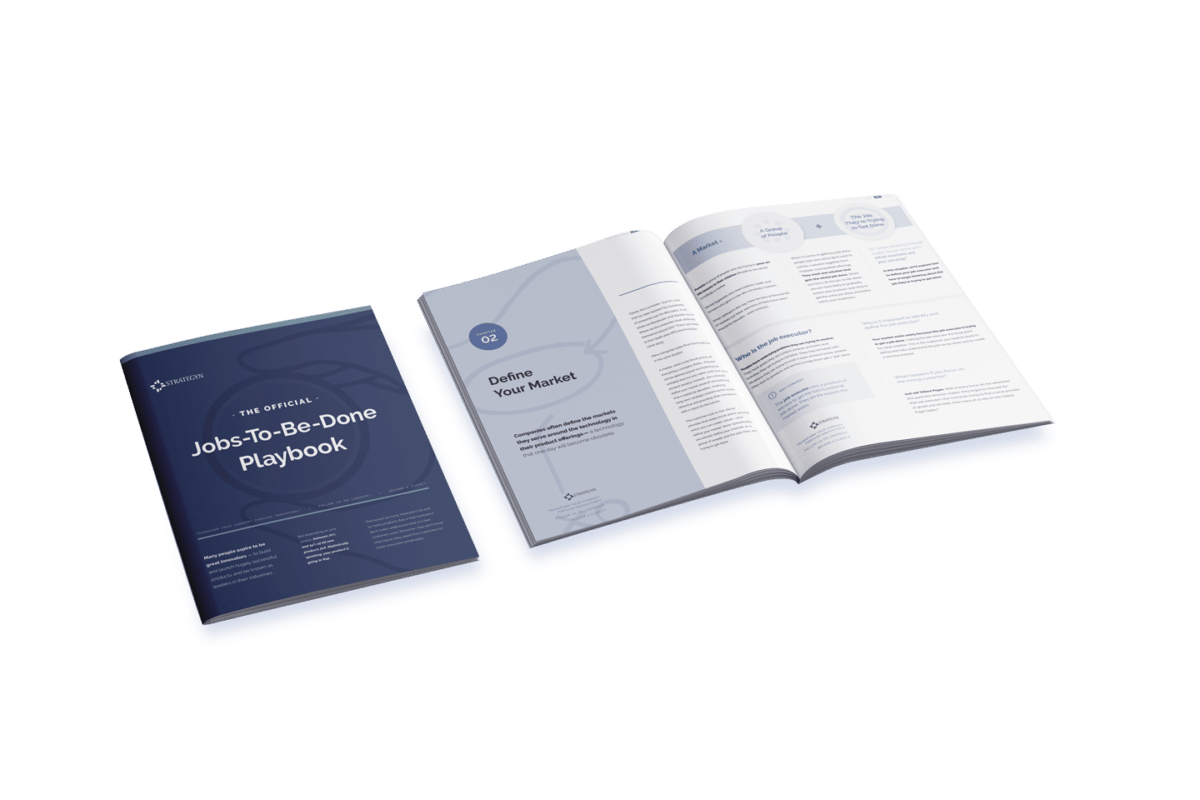
Free Download | The Official JTBD Playbook
Not quite ready to dive into a full book? The Official Jobs-to-be-Done Playbook may be a more approachable jumping-off point. Get more details on:
- Defining JTBD
- Defining your market
- Building your job map
- Putting JTBD into practice
Frequently Asked Questions
Jobs-to-be-Done (JTBD) is a theory of innovation that holds that people buy products and services to get a job done. A job is the task, goal, or objective a customer is trying to accomplish in a given situation. When a product helps customers get that job done better and/or more cheaply than competing solutions, it wins in the marketplace.
JTBD was pioneered by Tony Ulwick, founder of Strategyn, and later popularized by Harvard Business School professor Clayton Christensen. It reframes how companies define markets, understand customer needs, and make innovation decisions. A market is not defined around a product or a customer demographic. It is defined as a group of people plus the core functional job they are trying to get done.
The theory rests on three core principles:
Jobs are stable; products are not. The job customers are trying to get done remains constant even as technologies, products, and competitors change. This makes it a durable foundation for long-term strategy.
Customer needs are measurable. Needs are not vague preferences. They are the metrics customers use to measure success when getting a job done. These are called desired outcomes, and a single market can contain over 100 of them.
Innovation wins when it gets the job done significantly better. Products that get the job done 20% better or more than existing solutions are very likely to win in the marketplace.
At Strategyn, JTBD theory is put into practice through Outcome-Driven Innovation (ODI), a structured process with an 86% success rate, five times the industry average of roughly 17%.
The Jobs-to-be-Done framework is applied through Outcome-Driven Innovation (ODI), a step-by-step process developed by Tony Ulwick at Strategyn. ODI ties customer-defined metrics (desired outcomes) to the job-to-be-done, making innovation measurable and predictable.
The process follows six phases:
1. Define the customer and the job. Identify who is executing the job and define the core functional job in a single, solution-free statement. For example: “cut a piece of wood in a straight line” or “monitor a patient’s vital signs.”
2. Uncover customer needs. Use qualitative research and the Universal Job Map to capture all the desired outcomes tied to each step of the job. A single market typically contains 50 to 150 measurable desired outcomes.
3. Gather quantitative data. Survey a statistically valid population to measure the importance and current satisfaction of each desired outcome. This reveals which needs are underserved (unmet) and which are overserved.
4. Discover hidden segments of opportunity. Apply outcome-based segmentation to identify groups of customers with unique sets of unmet needs. These segments cannot be found through demographics, psychographics, or behavioral data alone.
5. Formulate the market strategy. Using the Jobs-to-be-Done Growth Strategy Matrix, determine which of five growth strategies to pursue: differentiated, dominant, disruptive, discrete, or sustaining.
6. Formulate the product strategy. Align product development, messaging, and positioning directly to the unmet desired outcomes of the target segment.
The result is an innovation process that predicts which products will win before they are built, reduces time to market, and eliminates the need to build, fail, and pivot.
Organizations apply Jobs-to-be-Done by adopting Outcome-Driven Innovation (ODI) as their core innovation process. The scale of adoption depends on the size of the organization.
Smaller organizations can engage directly with Strategyn to gather qualitative and quantitative data, while training a cross-functional team on how to use the resulting insights. This builds an innovation competency quickly and efficiently.
Larger organizations benefit from assembling a team of internal ODI practitioners who form the core of an Innovation Center of Excellence. This team applies Jobs Theory and ODI across carefully selected markets, transforming the company into an outcome-driven organization.
In both cases, organizational adoption follows three phases:
Understand your customer’s job-to-be-done. Cross-functional teams participate in a workshop where ODI practitioners engage customers using qualitative research. The team sees its market through a Jobs-to-be-Done lens for the first time and walks away with actionable customer insights.
Discover hidden opportunities in your market. ODI practitioners lead quantitative research to determine which desired outcomes are underserved and overserved, and which hidden customer segments have unique unmet needs.
Use new customer insights to drive growth. Marketing, sales, engineering, and R&D align around a shared market and product strategy grounded in customer-defined metrics, not internal assumptions.
The organizational benefit extends beyond any single project. ODI gives the business a common language for customer needs, a shared set of measurable performance metrics, and the confidence to align product innovation, messaging, and marketing strategy around what customers actually need.
The Outcome-Driven Innovation process has been applied across hundreds of companies worldwide, with an independently verified 86% success rate. Several landmark cases illustrate what becomes possible when innovation is grounded in the job-to-be-done.
Microsoft used ODI to transform its Software Assurance offering by identifying the specific outcomes IT professionals were trying to achieve when managing enterprise software. Microsoft discovered it already owned tools that addressed many unmet needs but had never packaged them effectively. In the year the revised offering was announced, Microsoft beat its revenue goal by over 10% before the fully updated product was even available.
Kroll Ontrack used ODI to define its market strategy for electronic document discovery, a market so new that customers could not yet articulate what they wanted. By focusing on the outcomes lawyers were trying to achieve rather than product features, Kroll Ontrack grew revenue from $11 million to over $200 million in approximately six years and was named the most-used electronic discovery provider by Law Firm Inc. for seven consecutive years.
Arm and Hammer Animal Nutrition adopted ODI after a series of technically successful but commercially disappointing product launches. Within one year, the business achieved over 30% revenue growth, with every product line delivering double-digit growth.
Bosch used ODI to uncover a hidden segment of tradesmen who struggled more than others when cutting wood in a straight line due to unique job complexities. The resulting circular saw generated more initial interest and sales than any other product the company had created at that time.
Cordis Corporation was among the earliest applications of the ODI process. By focusing on the outcomes cardiologists needed during angioplasty procedures, Cordis launched 19 products, all of which became number one or two in their market. Market share grew from 1% to over 20%.
Jobs-to-be-Done (JTBD) is a theory that explains why customers buy products and services. Outcome-Driven Innovation (ODI) is the methodology Strategyn created to put that theory into practice. Together, they differ from other innovation frameworks in one fundamental way: they start with a quantitatively validated understanding of what customers need before any solution is designed.
JTBD/ODI vs. Design Thinking Design Thinking is a qualitative, empathy-driven methodology built around observation, creative ideation, and iterative prototyping. It is effective at generating creative solutions and building user empathy. JTBD/ODI is quantitative. It uses statistically valid research to identify precisely which customer needs are unmet, in which segments, and to what degree. The core difference is rigor: ODI produces a data-defined target before ideation begins, while Design Thinking generates solutions before the opportunity is fully validated. The two approaches are complementary. Use JTBD/ODI to identify where to focus, then Design Thinking to explore solutions.
JTBD/ODI vs. Lean Startup Lean Startup is built around rapid experimentation and the build-measure-learn cycle. It is effective at eliminating bad ideas quickly. JTBD/ODI inverts this sequence: it identifies unmet needs with precision before any solution is built, reducing the need to fail and pivot. ODI enables a predict-build-succeed model rather than a build-fail-learn model.
What makes JTBD/ODI distinctly different Most innovation frameworks focus on the product or the customer. JTBD focuses on the job. Because jobs are stable over time, the insights generated through ODI are durable and strategically compounding. The quantitative tools built into ODI, including the Opportunity Algorithm, outcome-based segmentation, and the Jobs-to-be-Done Growth Strategy Matrix, produce strategic inputs that other frameworks do not generate. ODI has an independently verified 86% success rate across hundreds of client engagements, compared to an industry average of roughly 17%.

Tony Ulwick
Tony is the pioneer of Jobs-to-be-Done Theory, inventor of the Outcome-Driven Innovation® (ODI) process, and founder and CEO of Strategyn. Philip Kotler calls Tony “the Deming of innovation,” and Clayton Christensen credits him with “bringing predictability to innovation.” Published in Harvard Business Review and MIT Sloan Management Review, Tony is also the author of 2 best sellers: What Customers Want and JOBS TO BE DONE: Theory to Practice.