

Innovation Assessment Research – fINDING 02
How to assess market attractiveness, and why most organizations can’t do it reliably
Just 14% of innovation leaders are satisfied with selecting optimal target markets, according to our assessment of 393 validated respondents across various industries and organization sizes.
Strategyn’s Innovation Assessment: 393 validated responses from innovation leaders across industries and organizational sizes.
Table of Contents
Why most organizations can’t assess market attractiveness reliably
Market selection has a clear goal. Most organizations aren’t meeting it.
Of all the decisions an innovation function makes, this is among the most consequential. Which markets you enter determines where resources go, which opportunities get pursued, and which ones you hand to competitors.
Only 14% of leaders are satisfied
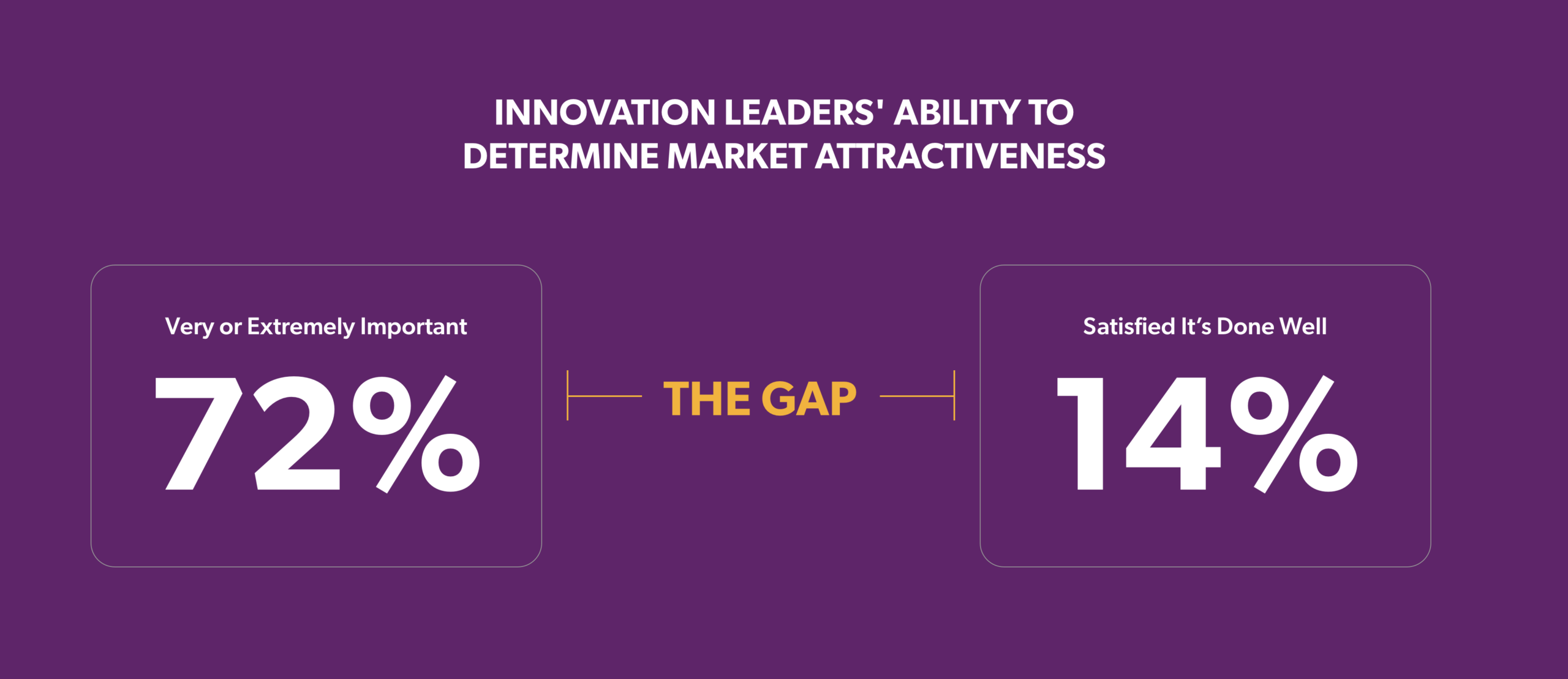
The problem isn’t effort or rigor. Market sizing built on category spend rests on assumptions, and assumptions compound. If the market is defined incorrectly at the start, every estimate derived from it is wrong in the same direction. More research produces more precision around the same mistaken foundation.
The reason most market attractiveness assessments feel inconclusive isn’t the quality of the analysis. It’s how the market was defined before the analysis began.
Here’s how ODI solves this.
How product-based market definitions create blind spots
When the market is the category, the category sets the limit of what you can see
But it creates a blind spot that’s difficult to see until the consequences are already visible.
| A market defined by the product Bounded territory | A market defined as a Job-to-be-Done Revealed Opportunities |
|---|---|
 | 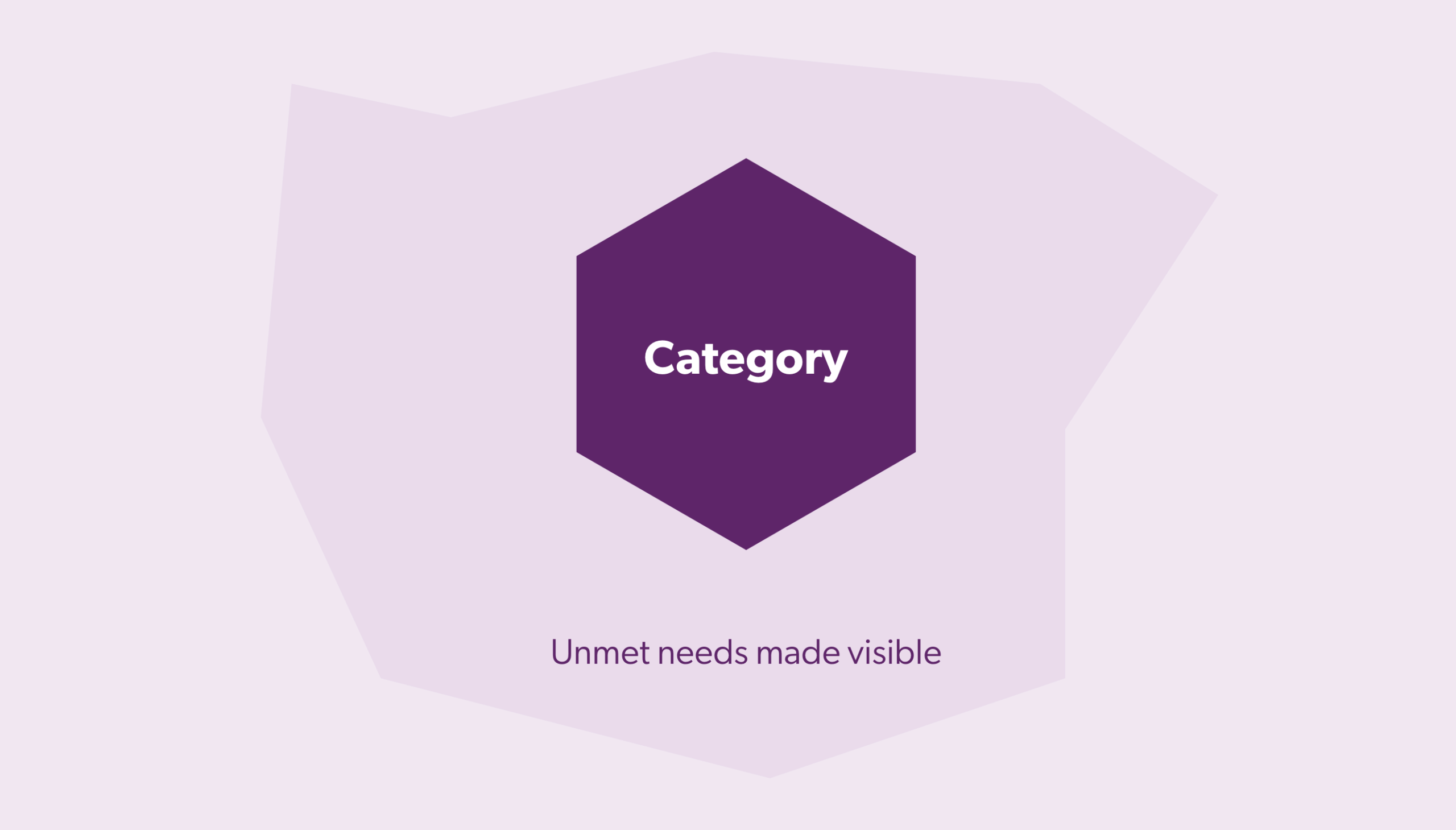 |
| Optimize for customers you already know. | See the full set of people executing the Job in your market. |
| Compete against the players you already track. | Surface outcomes that current products don’t address. |
| Solve the needs the current product already addresses. | Measure demand independent of the current competitive set. |
| Adjacent demand stays invisible — until a competitor captures it. | Opportunities that would be invisible inside a category appear as measurable demand. |
And when a competitor eventually captures demand that was always there, the question that follows is always the same: how did we miss that?
The answer is that the market was never defined in a way that would have let anyone see it.
Case Example: Adobe and Figma
(Adobe & Figma) A different market definition changes what’s possible to see
| Dimension | Market Definition as a Product Category | Market Definition as a Job-to-be-Done |
|---|---|---|
| Company | Adobe | Figma |
| Market Definition | Professional design software | Product collaborators trying to coordinate product development across teams |
| Unit of Analysis | The software category | The job-to-be-done |
| Who Counts as a Customer | Designers | Designers, PMs, developers, marketers, researchers, founders, operations teams |
| Core Assumption | People need better design tools | Teams need better coordination around product development |
| Scope of Competition | Design creation | Cross-functional collaboration and design coordination |
| Market Size | Limited to professional designers | Includes everyone participating in digital product creation |
| Strategic Blind Spot | Non-designers appear irrelevant | Two-thirds of users turn out to be non-designers |
| Growth Path | Compete within design software category | Expand across the entire product-development workflow |
Defined as the job of design (the cross-functional work of building products, involving product managers, developers, researchers, and marketers alongside designers), the market is fundamentally larger. The competitive set shifts. And two-thirds of Figma’s users turn out to be people Adobe never considered part of its market at all.
Adobe couldn’t see that demand from inside the product-category definition. By the time it tried to respond, the acquisition attempt cost $20 billion. Regulators blocked the deal. The market Adobe had missed was already built.
The definition didn’t change the work. It changed what was possible to see.
This is what a Jobs-to-be-Done market definition makes visible. Not a different methodology. A fundamentally clearer view of where demand actually lives and how well it’s currently being served.
When you define the market around the Job executor and the Job-to-be-Done, the competitive set becomes clearer and often larger. Demand that would be invisible inside a product-category definition appears as measurable opportunity.
What changes when you define markets around jobs
How to assess market attractiveness: what changes with a Job-based approach
When a market is defined around a Job-to-be-Done, the inputs to attractiveness assessment change.
You’re no longer estimating category spend and hoping the assumptions hold. You’re answering questions that have empirical answers: who is executing this Job, how often they’re doing it, and how well current solutions serve them.
Those inputs produce a view of demand that’s independent of how the current competitive set happens to be organized. When you know where demand is genuinely underserved, market attractiveness stops being a matter of narrative and modeling. It becomes a matter of measurement.
The result isn’t a more defensible slide. It’s a decision that feels settled because the foundation is sound.
Market selection is the first decision. Getting it right is necessary but not sufficient. Once you’ve defined the right market, a second gap emerges: understanding what customers within it actually need, with enough precision to guide what you build.
That’s Finding 3 from the same research.
If you want the step-by-step process for defining and sizing a market this way rather than by category, see how ODI’s market selection process works.
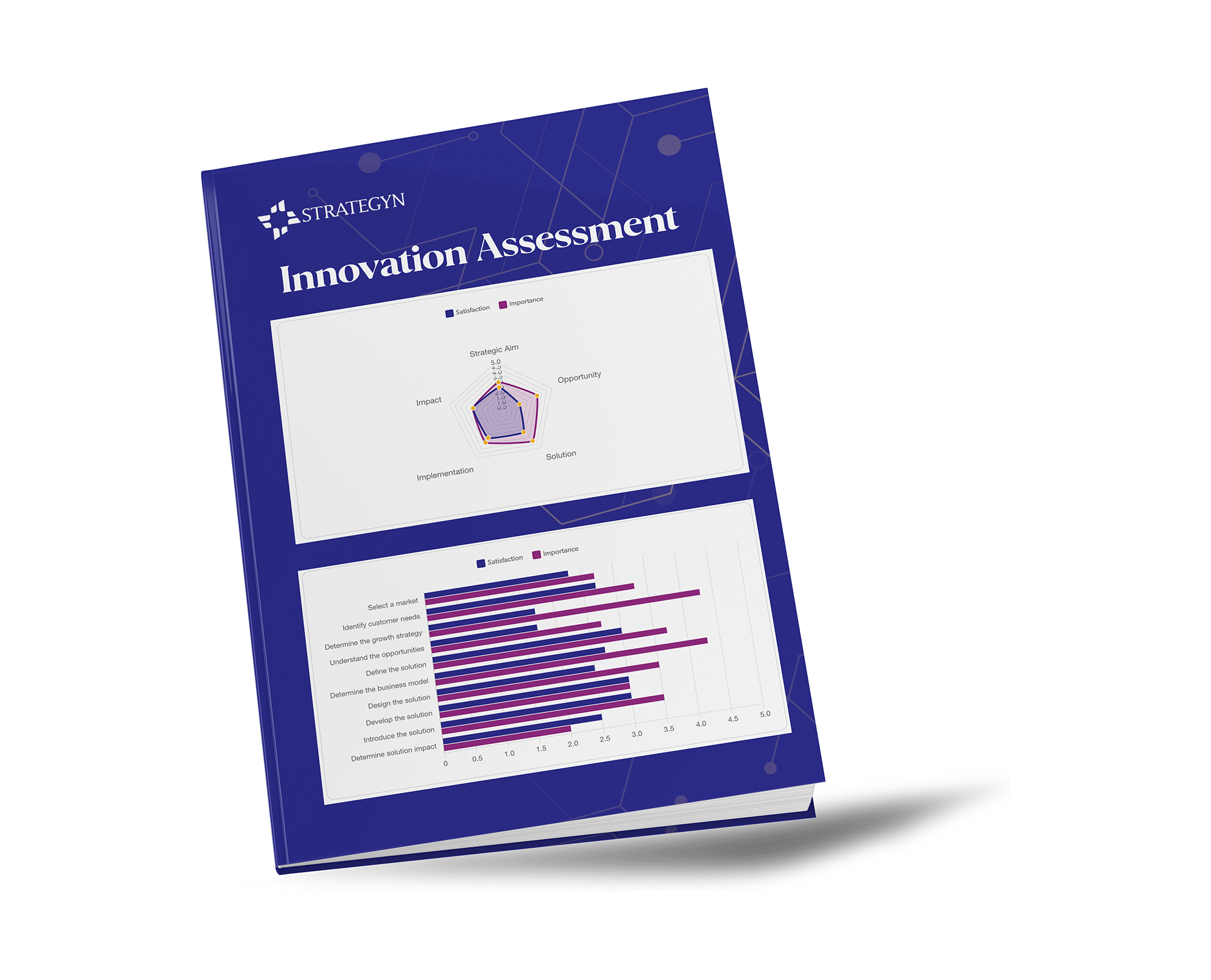
Innovation Assessment
Market selection is the highest-leverage decision in innovation.
Across 393 leaders in our research, it’s also the one organizations make least well.
FAQ’s
Market attractiveness assessment is the process of determining whether a given market is large enough, underserved enough, and structurally suited to support a new product or growth initiative. Most organizations assess attractiveness using category spend data and third-party growth forecasts. Those inputs describe how a market is currently served, not where demand is genuinely unmet, which is why the assessment often feels defensible but not settled.
The conventional approach uses TAM, SAM, and SOM estimates built on category spend and analyst forecasts. Strategyn’s research shows this produces the largest importance-satisfaction gap of all 26 decisions in the innovation process: 72% of leaders rate it critical, only 14% say they do it well. A more reliable approach defines the market around a Job-to-be-Done and answers three empirical questions: how many people are trying to execute this Job, how often, and how well do current solutions serve them? Those inputs produce a view of demand that is independent of the current competitive set and directly measurable.
A Jobs-to-be-Done market definition frames a market as a group of people (Job executors) trying to accomplish a specific outcome (the Job-to-be-Done), rather than as a product category or geography. When the market is defined this way, the competitive set expands to include everyone serving that need in any format, and demand that was invisible inside the product-category definition becomes visible. The Figma example illustrates this clearly: defined as professional design software, Adobe’s market was designers. Defined as the job of design (cross-functional product work involving PMs, developers, researchers, and marketers), two-thirds of the market turned out to be people outside the designer category entirely.