

Outcome-Driven Innovation®
Transform your innovation process from an art to a science. Our proven innovation process delivers an 86% success rate—5X the industry average.




As the front-end of innovation, ODI ensures your team is creating a winning product before development begins

How the ODI process works
Outcome-Driven Innovation is a strategy and innovation process conceived through a Jobs-to-be-Done lens. It includes all the steps a company must take to conceptualize and approve a product for development.

1. Define your market around the customer’s job-to-be-done
Companies traditionally define markets around a product, technology, geography, or vertical, but those are ineffective ways to define a market.
Since people buy products to get a job done, we define a market as a group of people and the job they’re trying to get done.
Defining your market around the “JTBD” instead of the technology or product allows you to fully understand what your customers are trying to do, build the products they want, and give your company a stable focal point for value creation.
The process defines a “market” in such a way that makes it:
- A stable focal point for long-term value creation – stable over time
- Customer-centric
- Independent of a solution
- A unit of analysis that enables a deep, empathic understanding of customer needs
Example:
Tradesmen (groups of people) cutting wood in a straight line (the JTBD) – This definition is independent of a solution and allows the team to focus on the best way to create value without the constraint of technology. In addition, the statement is valid for as long as tradesmen need to cut wood, whereas technologies come and go.


2. Uncover your customer’s outcomes (Perfect need statements)
Customers want to get their jobs done perfectly.
Customer needs traditionally focus on solutions, benefits, gains, requirements, exciters, specs, value drivers, etc.
Outcomes transform customer needs from vague preferences into precise, measurable targets for innovation, creating the “perfect” need statement.

Outcome statements:
- Inform all disciplines
- Knowable and discoverable
- Solution-independent
- Measurable and controllable
- Unambiguous
- Valid across geographies
- Stable over time
We use leading qualitative methods to uncover the 100+ outcomes your customers use to measure the successful execution of a job-to-be-done, define what perfection means – and instruct your company how to deliver it.

3. Determine which outcomes are unmet
Customers have underserved and overserved outcomes.
Knowing with statistical certainty which outcomes should be the focus of your value creation and cost reduction efforts and ensures the efficient deployment of resources.
Leveraging statistically valid primary quantitative research, the process reveals hidden opportunities, competitive strengths, targets for cost reduction, and more.
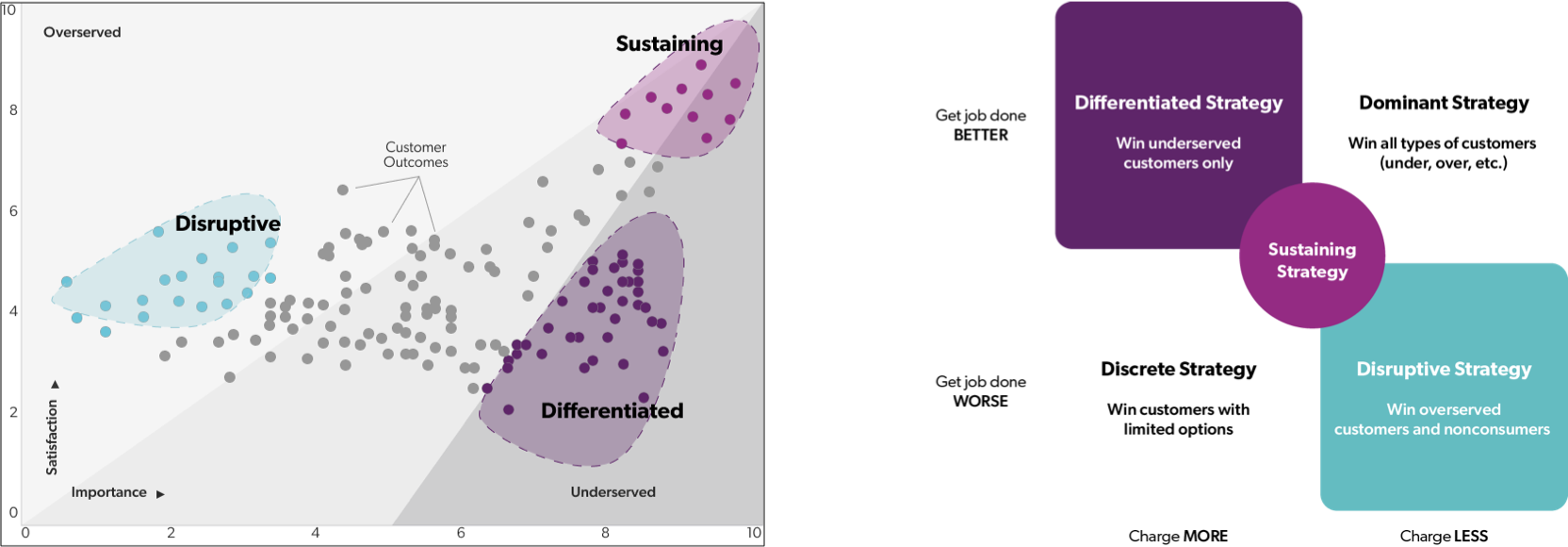
The Opportunity Landscape

To discover which outcomes are under and over-served, we have devised a mathematical formula we call the Opportunity Algorithm. It states that opportunity = importance + max(0, importance – satisfaction).
This formula reveals the most important and least satisfied customer outcomes, representing the best growth opportunities. We plot the scores on the opportunity landscape, revealing with precision where the market is under and over-served.
Teams know with certainty which of the 100+ outcomes are unmet and to what degree.

4. Discover hidden segments of customers
Customers rarely agree on which outcomes are unmet.
Segmenting your markets into groups of people with unique sets of unmet outcomes allows you to pursue opportunities your competitors will fail to see.
Traditional segmentation methods like demographic, psychographic, attitudinal, and behavioral segment classifications, along with use cases and personas, are proxies—and often result in targeting phantom segments.
This is why we segment the market directly around unmet outcomes. It produces segments of people with different unmet needs.
Using this approach, market segments are discovered in a way that makes them:
- Valid and distinctive: groups of people with different unmet needs
- Actionable: products can be targeted at the right segments using the right growth strategy
- Reachable through context and other characteristics
- Defensible: backed by data
- Hidden from competitors using traditional methods

5. Formulate the innovation and product strategy
The innovation strategy is the selection of segments and unmet outcomes to target for growth.
Knowing where the hidden opportunities lie, your company can better position and improve its existing products, fill gaps in its portfolio, make impactful R&D investment decisions, and more.
This purposeful exercise is the essence of positioning and strategy.
The strategy consists of these 3 critical elements:

Product segment fit
- First, the product team must decide which of its products to target at each of the outcome-based segments. This includes its current products, products in the pipeline, and products under consideration. Think of this as achieving product-segment fit.
- The team must also decide which segments to target with altogether new products, e.g., products that have not yet been conceptualized. This occurs when there are no solutions in the portfolio that match or address the opportunity.


Product strategy fit
- Next, the product team must decide which type of strategy should be pursued in each segment, e.g., differentiated, disruptive, dominant, etc., given the types of opportunities that exist. Think of this as achieving product-strategy fit.
- Each outcome-based segment possesses a set of characteristics that dictate the best growth strategy for that segment.

Product market fit
- Lastly, the product team must decide which of the unmet outcomes it wants to target for improved satisfaction with each product. This puts the team on the most efficient path to growth.
- The team applies Outcome-Driven Ideation® techniques to devise solutions that are certain to address the targeted unmet outcomes. This results in a product that successfully achieves product-market fit.

Build a long-term, customer-centric growth strategy
A shared understanding of the opportunities aligns sales, marketing, development, R&D, M&A and operations actions for long-term growth planning.

What people are saying about ODI






Outcome-Driven Innovation Vs. traditional methods
 | Traditional Consulting | Internal Innovation Initiatives | |
|---|---|---|---|
| Proven methodology | 86% success rate with proprietary ODI process validated over 30+ years and with hundreds of Fortune 500 implementations | Generic frameworks with 17% average success rate | Inconsistent processes with unpredictable results |
| Quality of customer insights | Systematically reveals 50-150 precise, measurable customer desired outcomes tied to the customer’s job-to-be-done | Surface-level customer insights based on demographics and preferences | Product-centric view based on internal capabilities and assumptions |
| Quantifiable results | Measurable outcomes are prioritized with statistically valid customer research | Random insights and subjective prioritization of opportunities | Metrics focused on internal targets rather than customer needs |
| Robust research findings | Insights are valid and actionable for 3-5 years | Short-term market snapshots that quickly become outdated | Ad-hoc research that may not connect to customer needs |
| Ideation | Creativity is focused on unmet outcomes that are underserved and certain to lead to the creation of winning products | Ideas are brainstormed before the customer’s unmet needs are discovered | Feature-focused ideation disconnected from customer jobs-to-be-done |
| Team alignment | Common language and framework for understanding customer needs which breaks down silos | Siloed opinions that prevent team alignment | Siloed efforts with competing priorities and metrics |
Battle-tested over three decades
Strategyn has completed 1500+ growth strategy engagements with a world-class blue-chip client base across 30+ industries—helping them generate billions of dollars in new revenue.

Success can be predictable
It’s time to stop relying on luck.
Set up a 30-minute Demo with one of our innovation practitioners to see how Outcome-Driven Innovation will help you achieve your business goals.