

Jobs-to-be-Done templateDownload the Jobs-to-be-Done template from the firm that pioneered Outcome-Driven Innovation, plus a Bosch worked example and the step most templates skip.
Table of Contents
They do not tell you which outcomes to measure, which segments to target, or which innovations will move revenue. That’s a different kind of template, and it’s the one we’ve used with Fortune 500 innovation teams for nearly three decades.
You can download it below, see a Bosch Power Tools example we walked through in the real world, and follow a section-by-section walk through of how to fill it in.
What is a Jobs-to-be-Done template?
The template on this page is built on Outcome-Driven Innovation® (ODI®), the methodology we pioneered and Tony Ulwick articulated commercially in his Harvard Business Review article, “Turn Customer Input Into Innovation.”
ODI sits on the quantitative side of Jobs-to-be-Done. It treats the customer’s Job as a stable unit of analysis, breaks that Job into its functional steps, and then captures the Desired Outcomes a customer uses to evaluate success in a form that survives a statistically valid survey. The template is the artifact that holds all of this in one place.
Download the template
→ Download the Jobs-to-be-Done template (PDF)
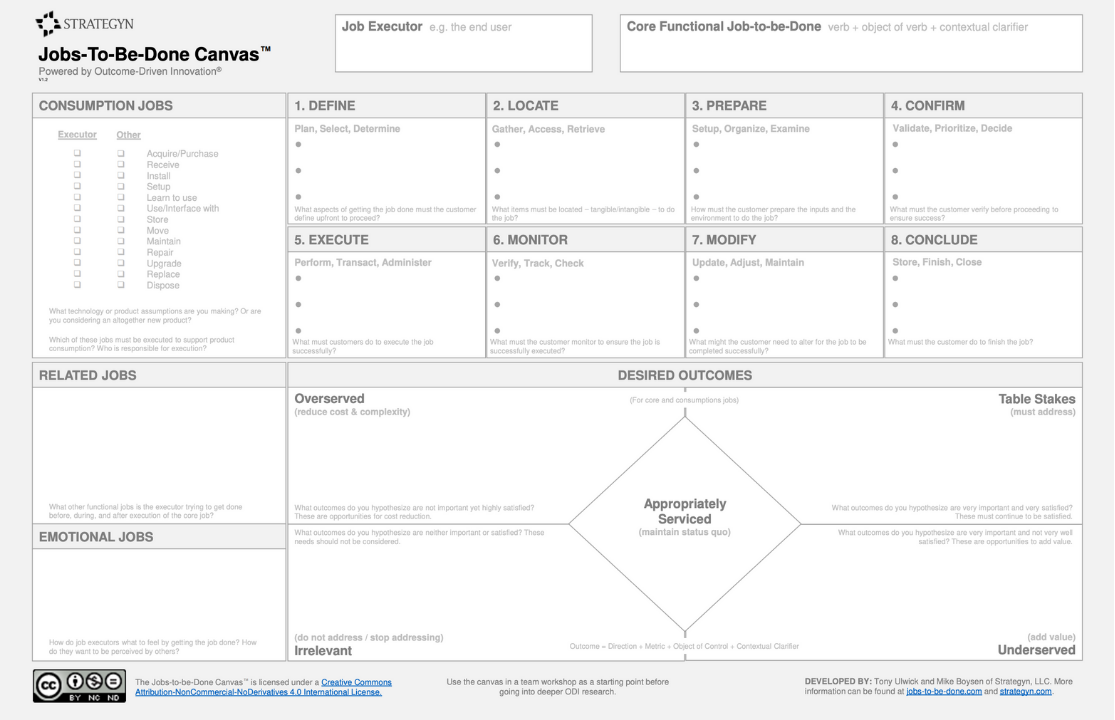
Same template we use with Fortune 500 innovation teams on day one of an engagement. When you open it, you’ll see seven named sections: Job Executor, the core functional Job-to-be-Done, the Job Map, Consumption Jobs, Related Jobs, Emotional Jobs, and Desired Outcomes. The next section walks you through what each one captures and why it’s there.
What goes inside the template?
The Job Executor
The Job Executor is the person actually getting the Job done in the moment. Not the buyer, not the economic decision-maker, not the persona on the marketing deck. The person whose hands are on the product.
Teams default to “our target customer” here and lose precision fast. A Job Executor is a specific role in a specific moment: not “contractors” but the tradesperson on a scaffolding, holding a cordless drill and a drywall screw, at the Confirm step of the Job. Start there, and the rest of the template gets easier.
The core functional Job-to-be-Done
The core functional Job is the stable statement at the center of the template. It follows a strict grammatical form so it survives across solutions, technologies, and decades:
Verb + object of the verb + contextual clarifier
An example:
Listen to music while commuting to work.
Stability is the whole point.

The Job Map
Every core functional Job breaks down into a universal sequence of steps a customer moves through to get the Job done.
There are eight:
- Define
- Locate
- Prepare
- Confirm
- Execute
- Monitor
- Modify
- Conclude

That’s the core functional Job and its map. Three more layers sit around them, and each one is where product teams tend to under-invest.
Consumption, Related, and Emotional Jobs
Three more layers surround the core functional Job. Each one broadens the design space without letting the team drift away from the Job itself.
Consumption Jobs are the Jobs the customer has to do to keep the solution working: set it up, maintain it, repair it, dispose of it. These are the ones product teams under-weight and customers remember.
Related Jobs are the other Jobs the customer wants done at the same time. A tradesperson drilling into concrete also wants to keep the worksite clean and finish the shift on time. Those Related Jobs shape which solutions the customer will accept.
Emotional Jobs are how the customer wants to feel, and how they want to be perceived, while getting the Job done. They are not the squishy layer; they are often where category leaders quietly win.
Desired Outcome statements
This is the step the “When I, I want to, so I can” templates don’t have. Without it, you have a story. With it, you have a quantifiable target.
A Desired Outcome is the measurable criterion the customer uses to judge whether the Job is being done well. Like the Job statement, it follows a strict grammatical form:
Direction of improvement + metric + object of control + contextual clarifier
An example from the power-tool world:
Minimize the time it takes to identify the correct drill bit size for the material being drilled.
Notice what the statement does. It’s solution-agnostic, it’s measurable, and it’s testable in a survey. That’s not an accident.
A Desired Outcome that can’t survive a survey can’t be converted into an Opportunity Score, and the Opportunity Score is where this whole methodology is headed.
A well-run template typically captures 50 to 150 Desired Outcomes across the core Job, its map steps, and the surrounding Jobs. That feels like a lot on the first pass. It’s the right order of magnitude.
A worked example: Bosch Power Tools
The Job Executor was straightforward: a tradesperson using a handheld power tool on a jobsite.
The core functional Job looked something like drill holes in materials at a worksite, and on the surface it’s a category everyone assumed had been optimized for a generation.
The Job Map told a different story. Most of the R&D and marketing effort in the category was concentrated on “Execute,” the drilling itself. That’s where the competitors’ product roadmaps were fighting.
But when the Bosch team mapped the full sequence and captured Desired Outcomes across all eight steps, the opportunity lived earlier. Tradespeople were spending disproportionate time and attention on “Prepare” and “Confirm” steps, including things like selecting the correct bit, minimizing the likelihood of snagging the cord on material, and minimizing the time it takes to make blade angle adjustments.
The resulting product decisions weren’t brainstormed. They were surfaced by under-served Desired Outcomes that no competitor was treating as design constraints. That’s the move. The template didn’t tell Bosch what to build; it told them where the category had ignored the customer.

→ Download the free book: Jobs to be Done: Theory to Practice. It’s the full methodology this template is pulled from, with the Bosch case in full plus five others.
This template vs. “When I, I want to, so I can” templates
It does not, however, produce a quantified opportunity map. It can’t tell a team which of the ten ideas on the whiteboard will move revenue. It can’t tell a CFO how to rank two markets against each other. It can’t survive the jump from “interesting customer insight” to “fund this.”
That’s the limit of the story-shaped approach, and it’s not a criticism of the people who use it. It’s a consequence of what those templates are designed to do.
The template on this page is designed to do something else. The Desired Outcome statement is the reason: a small grammatical constraint that turns a qualitative story into a quantitative variable.
From template to Opportunity Score
Each Desired Outcome becomes a pair of questions in a customer survey: how important is this outcome, and how satisfied are you with your current ability to get it done. Both are measured on a ten-point scale. The Opportunity Score:
Opportunity = Importance + max(Importance − Satisfaction, 0)
Outcomes that score high on importance and low on satisfaction are under-served. Those are the places where a new product, a new feature, or a new category entry can win. Outcomes that score high on both are over-served, and investing there is where competitors quietly lose the next decade.
We’re not going to teach the full scoring discipline on a blog page. Sample sizes, segmentation, and interpretation take a book to cover properly. The template gets you to the right statements; the methodology behind the template gets you to the right scores.
What to do after you’ve filled it in
Two paths from here.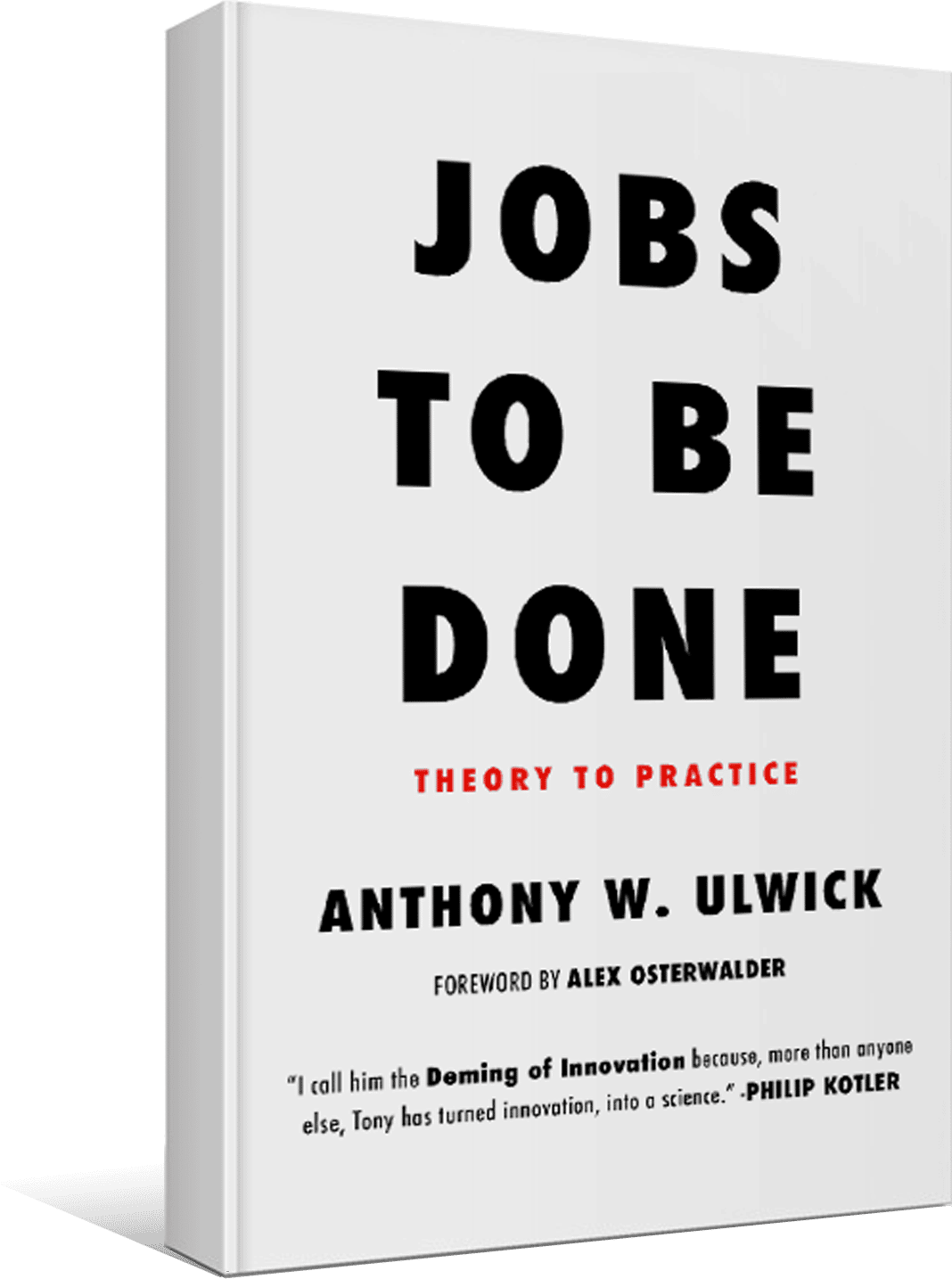
FAQ’s
A Jobs-to-be-Done template is a structured worksheet that captures one customer Job — the progress a customer is trying to make — along with the Job Steps, Desired Outcomes, and surrounding Consumption, Related, and Emotional Jobs that define how success gets measured. It’s the input artifact you fill in before running quantitative outcome research. The template is the skeleton of an innovation project: wrong template, wrong downstream data.
Six fields make up a complete template: the Job Statement (verb + object of verb + contextual clarifier), the Universal Job Map broken into eight steps (define, locate, prepare, confirm, execute, monitor, modify, conclude), the Desired Outcomes attached to each step, the Related Jobs the customer is getting done alongside the core Job, the Consumption Jobs that surround use of the product, and the Emotional Jobs that describe how the customer wants to feel. Together they form the opportunity space a survey can then score.
Jobs-to-be-Done is the theory; Outcome-Driven Innovation is the methodology that operationalizes it. JTBD is the lens — the idea that customers hire products to get Jobs done, and that Jobs are a more stable unit of analysis than features or demographics. ODI is the process: how to capture Jobs in a stable grammatical form, how to map them into steps, how to extract Desired Outcomes, and how to score those outcomes quantitatively.
Tony Ulwick founded Strategyn and developed Outcome-Driven Innovation over three decades of work with companies including Bosch, Kroger, Microsoft, and Johnson & Johnson. The methodology is documented in his books — What Customers Want (2005), Jobs to Be Done (2016), and Jobs to be Done: Theory to Practice — and taught through Strategyn’s ODIpro course.
The Job statement describes what the customer is trying to get done. It’s a stable declaration of purpose. The Desired Outcome statement describes one specific, measurable criterion the customer uses to judge whether the Job is going well. A single Job will have many Desired Outcomes attached to it. The Job tells you what. The outcomes tell you how well, and that’s what the survey measures.
A well-run template typically surfaces 50 to 150 Desired Outcomes across the core Job and the surrounding Consumption, Related, and Emotional Jobs. Any fewer and you’re under-sampling the opportunity space; many more and you’re probably restating the same outcome in different words. The template gives you the space to write them all down and then refine.
You can fill it in from memory, but the result will tell you what your team believes, not what your customers actually need. The template is an input artifact; customer discovery interviews are what populate it accurately. Jobs to be Done: Theory to Practice covers interview structure in detail, including how to avoid biasing the respondent and how to get to Desired Outcomes instead of feature requests.
Yes. The PDF and audiobook versions are both free. You enter an email on the download page, no payment required.
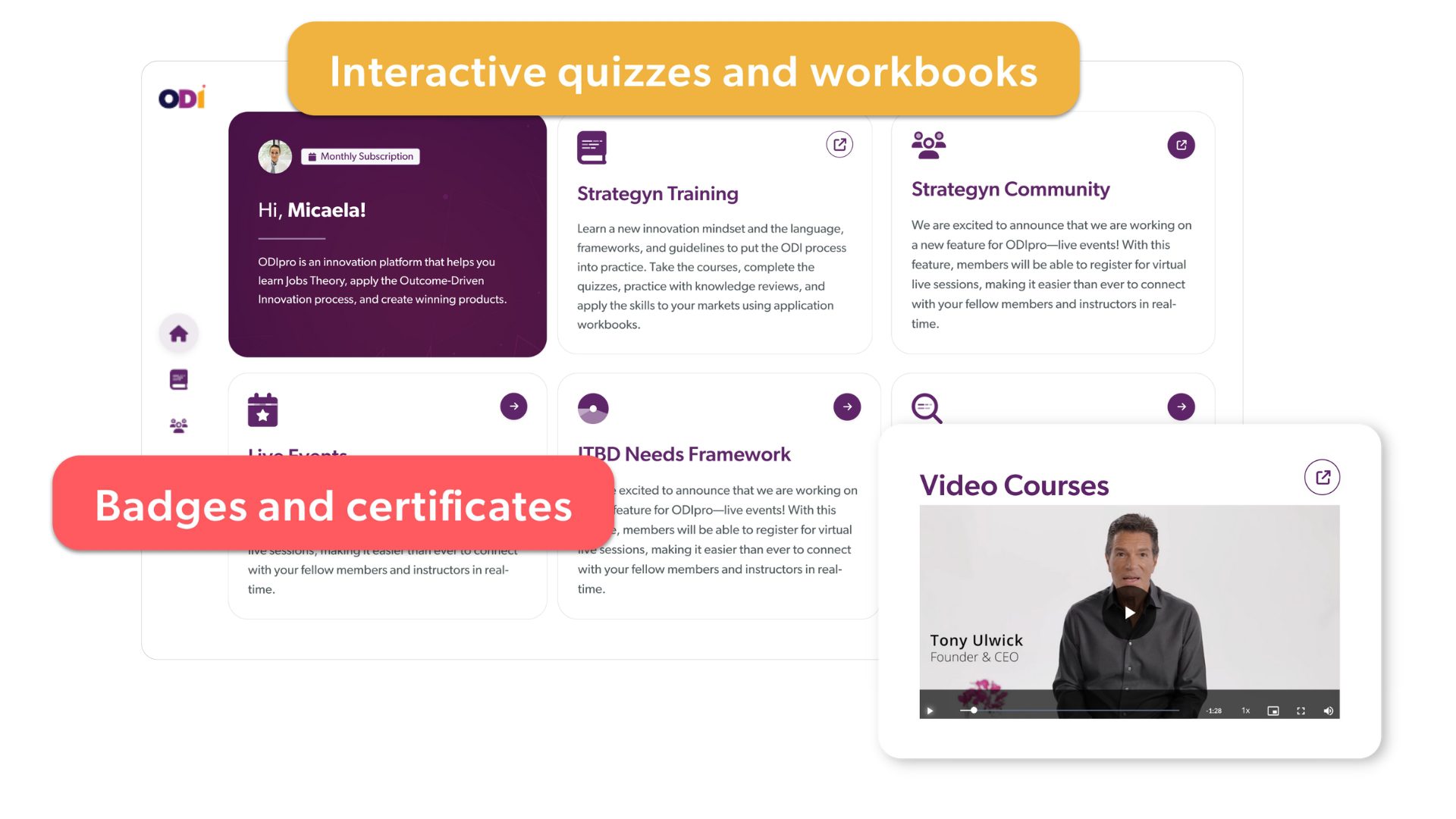
Two paths. ODIpro is Strategyn’s self-paced course for individual practitioners and internal innovation teams — it walks through the full methodology from Job definition through Opportunity Scoring. For full engagements, an Innovation Assessment is the right place to start; it’s the diagnostic Strategyn uses to size and scope a Fortune 500 project before committing to a phase-one build.

Tony Ulwick
Tony is the pioneer of Jobs-to-be-Done Theory, inventor of the Outcome-Driven Innovation® (ODI) process, and founder and CEO of Strategyn. Philip Kotler calls Tony “the Deming of innovation,” and Clayton Christensen credits him with “bringing predictability to innovation.” Published in Harvard Business Review and MIT Sloan Management Review, Tony is also the author of 2 best sellers: What Customers Want and JOBS TO BE DONE: Theory to Practice.