

Innovation Assessment Research – fINDING 01
Innovation doesn’t fail in development. It fails before development begins.
393 innovation leaders validated the pattern. The decisions that determine whether a product succeeds happen before a dollar is committed to building it. Most improvement efforts focus on execution. The data says fix the front end first.
Table of Contents
Where innovation actually breaks down
The front end of innovation is where things break down most often.
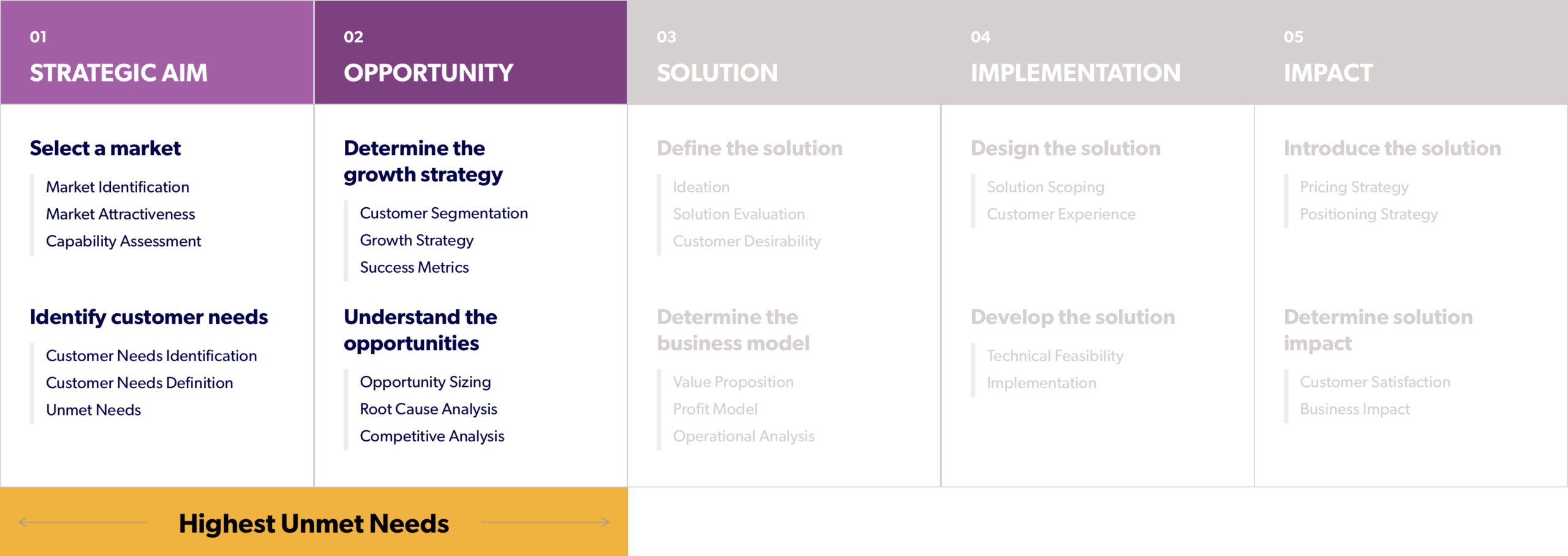
The results were consistent across company sizes, industries, and seniority levels. The decisions with the largest gaps clustered at the front end: establishing strategic direction, understanding customer needs, identifying which of those needs go unmet, and qualifying which opportunities are worth pursuing. These are the foundational decisions everything else depends on.
Execution, implementation, and launch decisions sat at the bottom of the ranking. Organizations are not struggling to build and ship. They are struggling to decide what to build and ship in the first place.
The findings draw on 393 validated responses, screened from 599 collected across three quality criteria: completion time, internal consistency, and respondent tenure. Thirty-five percent of respondents were C-suite or senior executive leaders. Strategy and Innovation functions represented the largest group (41%), followed by Product (19%) and Marketing (9%).
What the data shows: 393 leaders, 26 decisions
Organizations are focusing on the wrong stage of innovation.
This is not a commentary on execution quality. Most teams are capable of building what they’re asked to build. The problem is that they are often building the wrong things. The direction was set upstream, before the build began, and the direction was wrong.
| WHERE INVESTMENT GOES Most improvement spending lands downstream | WHERE THE PAIN LIVES Where the data says it’s actually needed |
|---|---|
| Agile delivery methods | Setting strategic direction |
| Faster iteration cycles | Defining the market precisely |
| Stronger launch process | Understanding customer needs |
| Cross-functional release rigor | Identifying which needs are unmet |
| Tooling, automation, telemetry | Qualifying which opportunities to pursue |
Why teams rush the front end — and what it costs
Speed through the front end doesn’t accelerate success. It accelerates the wrong work.
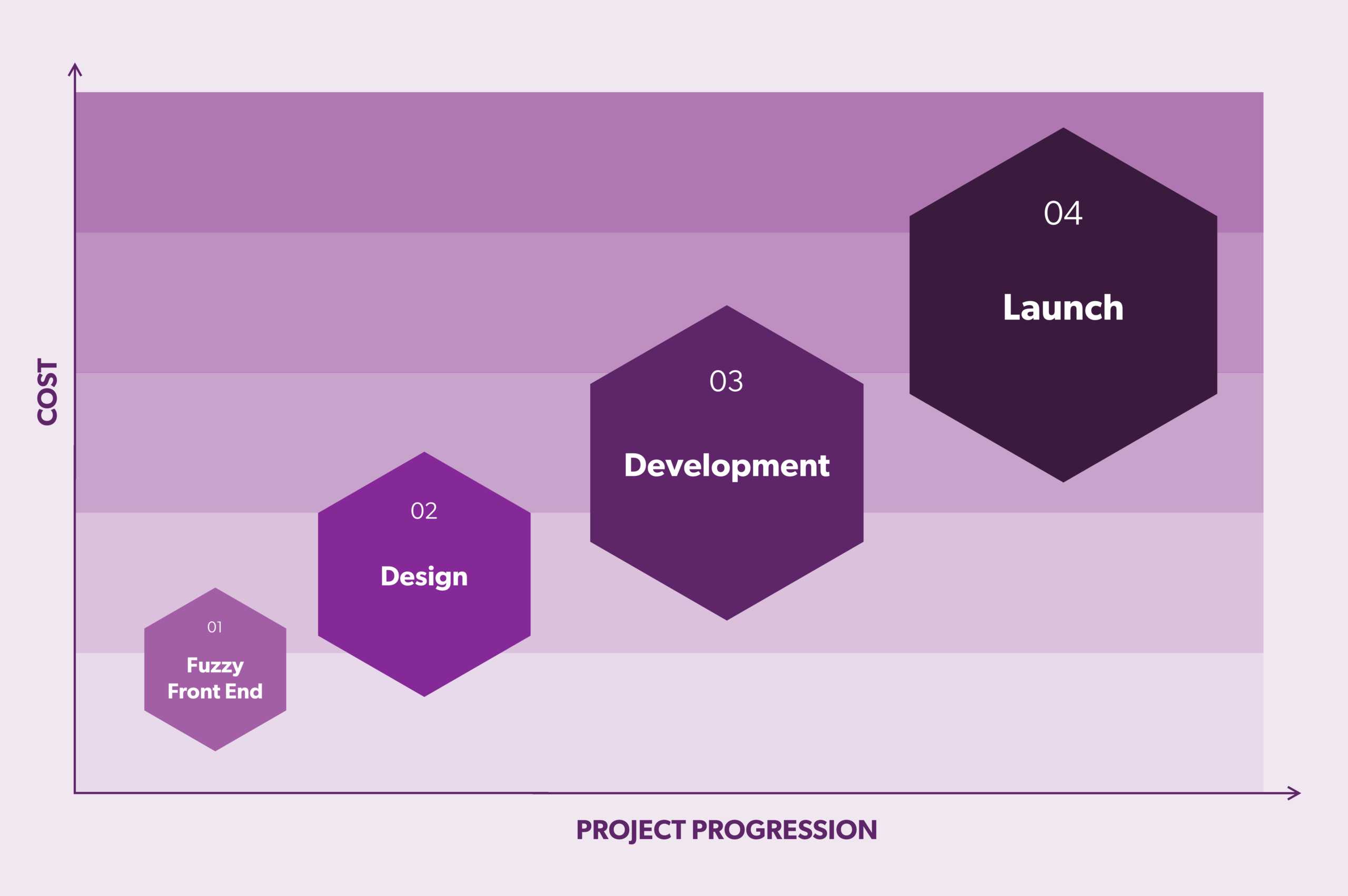
Speed through the front end accelerates what follows. If the foundation is sound, speed is a genuine advantage. If the foundation is weak, speed makes the problem harder to catch and more expensive to fix. By the time the consequences surface (a launch that underperforms, a market that doesn’t respond, a post-mortem that can’t explain what happened), the origin is months back, in decisions that felt confident when they were made.
The error cascade: from front end to launch failure
Execution teams aren’t failing. They’re inheriting the cost of earlier decisions.
If your organization has a pattern of product launches that didn’t perform, the instinct is to examine how the work was done. The data from 393 innovation leaders points to a different question: how were the early decisions made?
Scale
At enterprise scale, weak early decisions get expensive fast
A directional error at enterprise scale carries real weight. Dozens of people may be aligned to a wrong direction before its flaw surfaces. Budget has been committed. A reversal means reorienting stakeholders and explaining the change to a board that approved the original bet. The cost of catching an error late rises sharply as organizations grow.
The organizations in this dataset range from growth companies to large enterprises. Across all of them, the front end is where the pain concentrates. What changes as organizations grow is not the nature of the problem. It’s the price of getting it wrong.
The fix: Outcome-Driven Innovation
How to fix the front-end of the innovation process.
Front-end decisions stay weak for a structural reason: most organizations have no reliable way to quantify which of them are wrong and by how much. Without that, improvement efforts default to the stages where progress is visible and measurable.
Outcome-Driven Innovation® (ODI®), the methodology Strategyn has applied across thousands of enterprise engagements over thirty years, makes front-end decisions measurable. It quantifies which customer needs go unmet in a given market and which opportunities are worth pursuing, based on the size of those unmet needs, before a single resource is committed to solving them. That quantification is what turns the front end from a set of judgment calls into a repeatable discipline.
VS
5-20%
Industry Average
Organizations that treat the front end as a discipline stop wondering why their innovation results vary. They know which decisions to make differently, and they can make them with confidence before the expensive work begins.
HOW ODI WORKS
The methodology that makes front-end decisions measurable →
Innovation Assessment
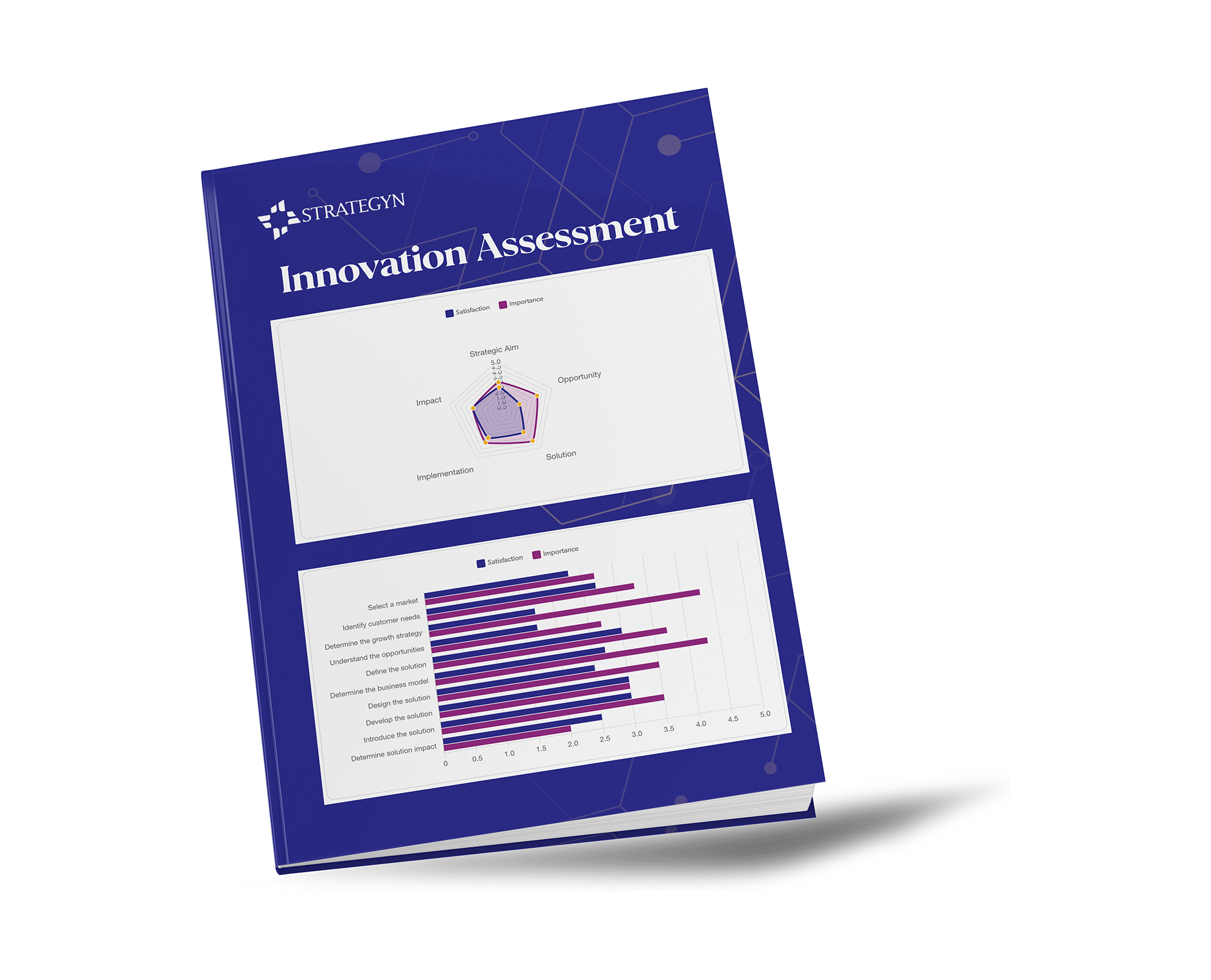
Diagnose which front-end decisions are costing your organization most.
Free. 10 minutes. Personal results.
FAQ’s
The front end of innovation is the stage before significant resources are committed to development. It encompasses the decisions about where to compete, whose problems to solve, and which opportunities to pursue. These early-stage decisions determine whether an innovation effort succeeds long before any product is built.
Data from 393 innovation leaders shows that front-end decisions rank highest in unmet need across all 26 decisions in the innovation process. Organizations tend to rush through early-stage ambiguity, setting weak strategic direction, imprecise customer needs, and unqualified opportunities. Execution teams inherit these upstream problems and are blamed for failures that originated months earlier in decisions nobody marked as decisions.
Outcome-Driven Innovation® (ODI®) makes front-end decisions measurable by quantifying which customer needs go unmet in a given market and which opportunities are worth pursuing, before resources are committed. Strategyn’s Innovation Assessment is a free, 10-minute diagnostic that shows where an organization’s front-end decisions are weakest. ODI has produced an 86% innovation success rate across client engagements, more than four times the industry average of 5 to 20 percent.